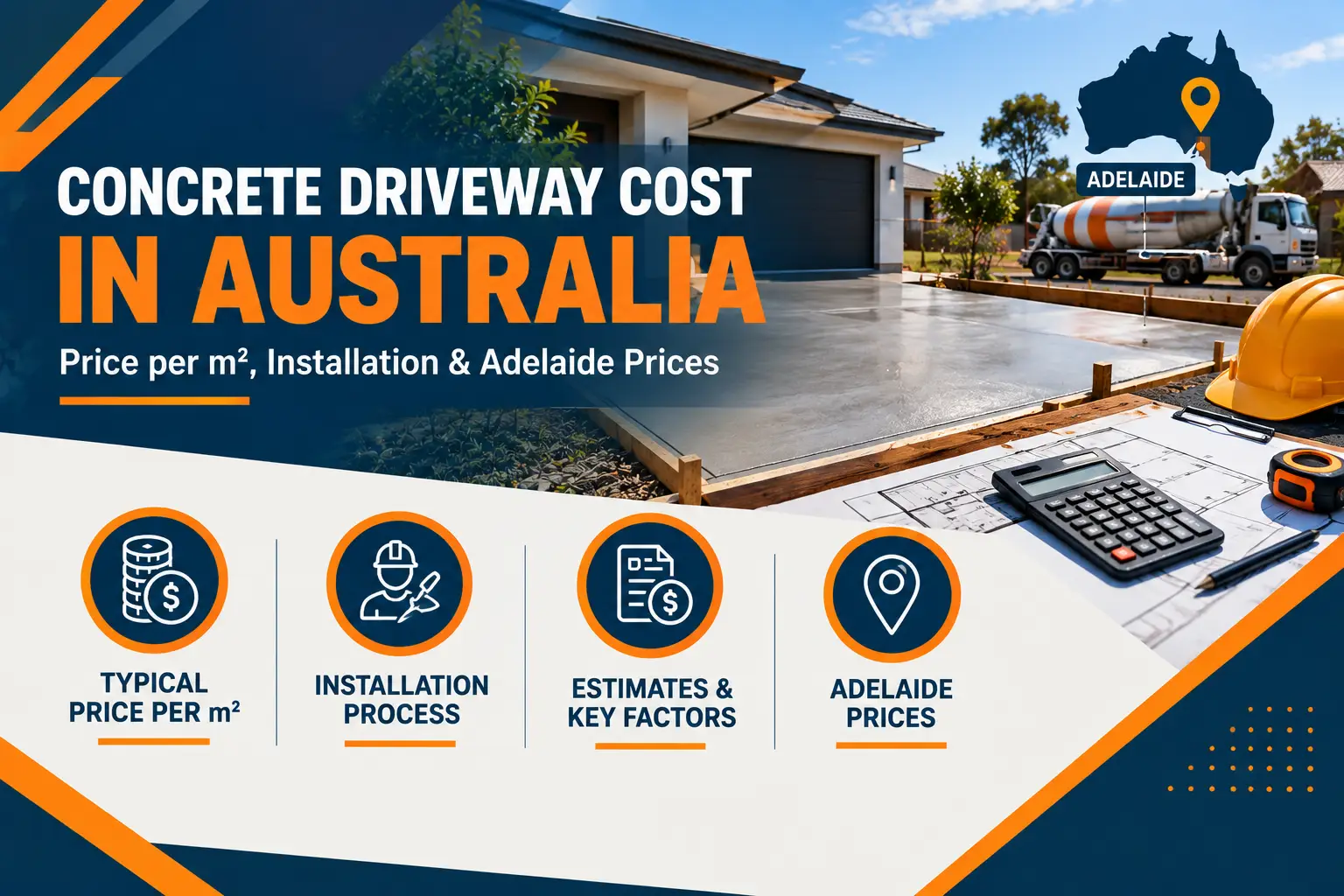
A concrete driveway costs about $60 to $180 per square metre installed in Australia, with plain concrete usually at the lower end and decorative finishes at the higher end. An 18 m² single-car driveway can cost $1,100 to $2,700, while a 40 to 50 m² double driveway can cost $3,000 to $9,000 before unusual site work.
Your final concrete driveway cost depends on driveway size, slab thickness, concrete strength, reinforcement, site preparation, access, finish, drainage, demolition, and council requirements. Adelaide prices can differ from other Australian locations because labour, delivery, demand, and approval requirements vary.
Average concrete driveway cost per square metre
The average concrete driveway cost is $60 to $180 per square metre installed, depending on finish and site conditions. Plain concrete generally costs $60 to $85 per m², coloured concrete $75 to $120, exposed aggregate $100 to $180, and stamped or stencilled concrete $100 to $200 per m².
| Driveway finish | Typical installed cost |
| Plain concrete | $60–$85/m² |
| Coloured concrete | $75–$120/m² |
| Exposed aggregate | $100–$180/m² |
| Stamped or stencilled | $100–$200/m² |
These figures provide a planning range for standard residential work on a prepared site. Excavation, old driveway removal, drainage, difficult access, pump hire, premium aggregate, or substantial base work can push the final cost above the standard rate.
Concrete driveway cost by size
Driveway size directly affects total cost because contractors calculate concrete, reinforcement, labour, formwork, and finishing from the measured area. Larger driveways require more materials and labour, although larger projects can receive a lower rate per square metre because setup costs spread across more area.
An 18 m² single driveway can cost about $1,100 to $2,700. A 30 m² driveway can cost about $1,800 to $4,500, depending on finish. A 40 to 50 m² double driveway can cost $3,000 to $9,000. A 100 m² long driveway can reach $15,000 or more with decorative concrete and site work.
A 16 m × 6 m driveway covers 96 m². At $100 to $150 per m², the concrete installation represents about $9,600 to $14,400 before major removal or preparation costs. A $16,000 quote can be reasonable when the scope includes reinforcement, excavation, formwork, drainage, finishing, and disposal.
Concrete driveway finishes and prices
The finish you select can change concrete driveway cost substantially because decorative concrete requires different materials, preparation, labour, and finishing methods. Plain, coloured, exposed aggregate, stamped, and stencilled surfaces provide different price points and maintenance requirements.
Plain concrete finish
Plain concrete is usually the most affordable driveway finish at about $60 to $85 per m² installed. Standard grey concrete provides a practical surface with straightforward construction, simple maintenance, and compatibility with existing paths, landscaping, and residential facades.
A plain concrete driveway suits homeowners who prioritise function and budget over decorative detailing. A broom or textured finish can provide traction without the cost associated with complex patterns or multiple colours.
Coloured concrete
Coloured concrete generally costs $75 to $120 per m² installed. Pigment within the concrete mix creates a consistent base colour, while borders or contrasting sections can add labour and material costs.
Coloured concrete provides more visual choice than plain concrete without reaching the highest decorative price bands. Choose a colour that works with the existing house, paths, kerbs, and landscape materials.
Exposed aggregate
Exposed aggregate usually costs $100 to $180 per m² installed and is one of the most popular premium driveway finishes. The surface reveals selected stone within the concrete, creating texture and a decorative appearance.
Aggregate selection affects price because stone type, colour, availability, and grading vary. Sealing protects the finished surface and helps maintain appearance where the driveway receives strong sunlight, vehicle traffic, and regular exposure to contaminants.
Stamped and stencilled concrete
Stamped or stencilled concrete commonly costs $100 to $200 per m² installed because patterns, colours, borders, and detailed finishing require additional labour. Stamped concrete uses moulds to create patterns, while stencilled systems create defined designs with surface treatments.
These concrete driveway finishes can reproduce the visual character of brick, stone, or paving without separate paver installation. Complex layouts and multiple colours raise labour requirements, so request a clear design specification before accepting a quote.
What factors affect concrete driveway cost?
The main factors are size, concrete thickness, reinforcement, ground conditions, slope, access, finish, drainage, removal, and local labour rates. Each factor changes material quantities, preparation time, equipment requirements, or construction complexity.
Concrete thickness and reinforcement
A standard residential slab commonly uses about 100 mm thickness with reinforcement suitable for normal vehicle loads, while heavier vehicles can require a thicker slab and stronger reinforcement. A driveway that carries caravans, boats, or vehicles above two tonnes may require approximately 125 mm thickness and higher reinforcement.
Concrete thickness and concrete reinforcement should match expected load and ground conditions. Ask the contractor to state slab thickness, concrete strength in MPa, reinforcement type, and base specification on the concrete driveway quote.
Site preparation
Site preparation can add about $15 to $50 per m² when excavation, fill, formwork, or difficult ground conditions are required. Preparation may involve removing vegetation, excavating unsuitable soil, compacting a sub-base, establishing levels, installing forms, and correcting drainage.
Poor preparation can cause settlement, cracking, uneven levels, and water problems. The contractor should inspect the ground rather than assume that a visually stable surface provides a suitable foundation.
Slope and access
A sloping driveway can add roughly $10 to $20 per m² because excavation, formwork, drainage, and base construction become more complex. Restricted access can create additional equipment and labour requirements when a concrete truck cannot reach the pour area.
Pump hire can cost about $500 to $900 per day where concrete placement requires a pump. Confirm access requirements before comparing quotes because contractors can price the same measured area differently.
Driveway removal
Removing an old driveway can add about $30 to $80 per m² when demolition, machinery, loading, transport, and disposal are required. Thick reinforced concrete can cost more to remove than a thin or unreinforced surface.
Ask whether the quote includes complete driveway removal or only demolition. Confirm disposal arrangements because landfill charges and transport can create separate costs.
Concrete driveway cost breakdown
A complete driveway quote should separate demolition, excavation, base preparation, concrete supply, reinforcement, labour, finishing, joints, sealing, and disposal. An itemised breakdown lets you compare quotes based on actual scope rather than a single total.
Concrete supply and pouring form the central construction cost. Reinforcing mesh, formwork, concrete volume, labour, finishing equipment, and curing requirements add to the project total.
Concrete volume affects the quote. A 50 m² driveway at 100 mm thickness requires about 5 m³ of concrete before allowing for wastage, ordering tolerances, or site-level changes. Accurate volume calculations help prevent shortages and unnecessary surplus.
Finishing and sealing create separate costs for decorative surfaces. Exposed aggregate usually requires sealing, while sealing plain concrete depends on finish, exposure, and maintenance objectives.
What is the cost of a concrete driveway in Adelaide?
Concrete driveway prices Adelaide commonly fall within the national range of about $60 to $180 per m², but local labour, supply, access, site conditions, and council requirements determine the final quote. Plain concrete usually provides the lowest installed rate, while exposed aggregate and stamped finishes cost more.
Adelaide projects can differ substantially even when two driveways have identical dimensions. A flat, accessible block with a prepared base requires less work than a sloping site with an old driveway, restricted access, drainage problems, or extensive excavation.
Ask Adelaide concreters for itemised quotes that specify concrete strength, slab thickness, reinforcement, finish, excavation, disposal, and crossover work. A local site inspection provides a more reliable estimate than an online average.
Council crossover permits and approvals
Council approval may be required when a driveway crosses the footpath, verge, or road reserve because the crossover section involves public land and local council controls. Permit fees and approval periods vary between councils, so check requirements before booking concrete work.
Some Australian councils charge several hundred dollars for crossover applications or inspections, while other councils use different fee structures or subsidies. The City of Casey and City of Canning provide examples of council-specific requirements and fees, but your local council determines the applicable rules.
Confirm who will arrange the permit, who pays the application fee, and whether the contractor includes crossover construction in the concrete driveway quote. Approval can affect the project schedule, so allow adequate time before demolition or concrete delivery.
How to save money on a concrete driveway
You can reduce driveway costs by choosing a simple layout, comparing itemised quotes, limiting decorative extras, and avoiding unnecessary demolition or excavation. Cost reduction should never involve unsuitable slab thickness, inadequate reinforcement, poor drainage, or weak base preparation.
Use plain concrete where appearance is not a priority and reserve decorative finishes for borders or high-visibility sections. A straightforward rectangular layout usually requires less formwork, cutting, labour, and finishing time than complex curves.
Get at least three comparable quotes and give each contractor the same dimensions, finish, thickness, reinforcement requirements, access information, and site details. Consistent specifications make price comparison more meaningful.
Schedule the project outside peak periods when contractor availability allows, but never choose a date that creates avoidable weather or curing risks.
Is a concrete driveway worth the cost?
Yes, a concrete driveway can provide strong long-term value because concrete offers durability, low routine maintenance, and a service life that can reach several decades when construction quality matches site conditions. Concrete usually costs more upfront than asphalt but can require fewer major resurfacing cycles.
Concrete can improve street presentation through plain, coloured, exposed aggregate, stamped, or stencilled finishes. Correct joints, drainage, reinforcement, thickness, and curing remain important for long-term performance.
The most cost-effective driveway is not necessarily the cheapest initial quote. A low quote that excludes base preparation, reinforcement, disposal, drainage, or required approvals can create repair costs later.
Concrete vs asphalt vs pavers
Concrete usually costs more upfront than asphalt, while asphalt driveway installation can provide a practical alternative for homeowners seeking a lower initial cost. . Asphalt driveway costs are often lower initially, whereas concrete offers a broad choice of finishes and strong performance when correctly installed.
| Material | Typical installed cost | Typical service life |
| Concrete | $60–$180/m² | 30–40 years |
| Asphalt | $25–$100/m² | 15–20 years |
| Pavers | $70–$160/m² | 30+ years |
Actual lifespan depends on drainage, ground stability, traffic, construction quality, climate, and maintenance. Compare installation, maintenance, repair, and replacement costs rather than only the initial square metre rate.
How to compare a concrete driveway quote
Compare each quote by checking the exact scope, material specification, preparation, reinforcement, finish, drainage, disposal, warranty, and exclusions. A cheaper total does not provide better value when essential work is omitted.
Ask each concreter to confirm:
- Total driveway area in square metres
- Slab thickness and concrete MPa
- Reinforcement type and placement
- Base material and preparation depth
- Concrete finish and colour
- Expansion and control joints
- Excavation and old driveway removal
- Drainage and crossover requirements
- Pump hire or restricted-access charges
- Sealing and curing requirements
- Waste removal and final clean-up
A reliable contractor should explain site conditions and identify costs that cannot be confirmed until excavation exposes the existing ground. Request written confirmation of variations before additional work begins.
How long does a concrete driveway take to install?
Most residential driveway projects take several days for demolition, preparation, formwork, pouring, finishing, and initial curing, while larger or complex sites can take longer. Weather, access, driveway size, drainage, decorative finishes, and site preparation affect the schedule.
Fresh concrete needs protection during early curing. Foot traffic may be possible after roughly 24 to 48 hours, but vehicle traffic generally should remain off the driveway for about seven days, while heavy loads may require longer curing.
Your contractor should provide a practical schedule that identifies demolition, preparation, pour date, finishing, curing, and vehicle access restrictions.
Concrete driveway maintenance and lifespan
Regular cleaning, drainage control, joint maintenance, and appropriate sealing can help preserve a concrete driveway for decades. Plain concrete needs relatively little routine maintenance, while exposed aggregate and other decorative finishes benefit from appropriate sealing.
Remove stains promptly, keep drainage paths clear, and address cracks before water reaches the base. Avoid heavy loads on slabs that were not designed for those loads.
Sealing frequency depends on the finish, exposure, product, and manufacturer instructions. Exposed aggregate commonly needs resealing every few years, while plain concrete may not require routine sealing.
Conclusion
A well-planned concrete driveway requires more than selecting a finish and multiplying the area by a square metre rate. Your final cost depends on the complete construction scope, including site preparation, concrete thickness, reinforcement, drainage, access, approvals, and finishing.
Bitmac Civils can assess driveway requirements and help you plan suitable civil and concrete works. Request a detailed concrete driveway quote that clearly identifies every included cost before approving the project.
Frequently Asked Questions
How much does a concrete driveway cost in Australia?
A concrete driveway costs about $60 to $180 per square metre installed in Australia, depending on finish and site conditions. An 18 m² single driveway can cost $1,100 to $2,700, while a 50 m² double driveway can cost $3,000 to $9,000.
How much for a 20×20 concrete driveway?
A 20 m × 20 m concrete driveway covers 400 m² and can cost about $24,000 to $72,000 at $60 to $180 per m² installed. Extensive excavation, decorative finishes, drainage, reinforcement upgrades, restricted access, or demolition can push the project above this range.
Is a concrete driveway cheaper than asphalt?
No, concrete and asphalt driveway costs can differ substantially upfront, with concrete generally costing more than asphalt. Concrete costs about $60 to $180 per m² installed, compared with roughly $25 to $100 for asphalt, but concrete can last 30 to 40 years.