Welcome to Bitmac Civils Pty Ltd. 0477 803 702

Adelaide, S.A 0477803702
Your roads, car parks, and work sites need clear, accurate markings to stay safe and functional. Bitmac Civils delivers professional road line marking services across Adelaide that meet Australian standards and hold up under real-world conditions.
Road markings are not just painted lines. They tell drivers where to stop, where to turn, and where pedestrians have the right of way. On commercial sites, they separate vehicle paths from foot traffic and define parking zones with precision. Without accurate road markings, your site becomes a liability, one that invites accidents, fails safety audits, and leaves you open to legal exposure. Properly applied road safety markings put structure where confusion costs you the most.
At Bitmac Civils, we handle road line marking across Adelaide for a wide range of clients, from local councils and property developers to logistics companies and commercial site operators. Whether you need line marking for a new car park, a warehouse floor, a public road, or a private access route, our team arrives prepared with the right equipment and materials for the job. We plan each project around your specific site layout, traffic volumes, and compliance requirements, so every line we apply serves a clear, functional purpose and performs well under daily use and heavy traffic.
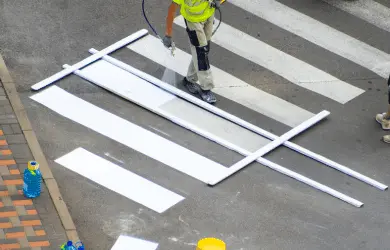
Clear road markings on active routes reduce accidents at junctions, roundabouts, and pedestrian crossings. We apply centre lines, lane dividers, stop lines, give-way markings, and directional arrows on roads in and around Adelaide. Every marking follows current Australian standards for road line marking, so your road stays safe and fully compliant from day one.
A car park without clear markings creates confusion, raises the risk of vehicle collisions, and puts you in a difficult legal position. Our car park line marking services cover standard bays, accessible bays, no-parking zones, directional arrows, and pedestrian pathways. We also handle full car park layout planning for new or resurfaced areas, so the finished result works for both vehicles and foot traffic without guesswork.
In warehouses and industrial sites, clear floor markings keep operations safe and audit-ready. We mark pedestrian walkways, forklift lanes, loading bays, hazard areas, and storage zone boundaries with accuracy. For any site where vehicles and workers share the same floor, warehouse floor markings reduce the risk of incidents and meet Australian workplace safety requirements.
From public roads to internal commercial floors, Bitmac Civils identifies the right marking solution for every area of your site and applies it with the precision the job demands.
The material behind road line marking matters more than most clients realise. At Bitmac Civils, we use thermoplastic, water-based paint, solvent-based paint, and epoxy, each matched to the surface type, traffic conditions, and expected wear. For routes with low-light exposure or high-speed zones, we apply reflective road markings with glass bead technology to keep lines visible at night and in wet weather. We also use precision marking machines and stencils for symbols, arrows, and text; every technique chosen to match exactly what the site demands.
Road markings in Australia must comply with AS 1742, the Australian Standard covering road marking materials and application methods. Non-compliant markings on public roads or commercial sites can lead to failed audits, council rejections, and legal exposure. At Bitmac Civils, every road line marking project follows current AS 1742 requirements and relevant Western Australian state guidelines. We document our work and use compliant materials throughout, so you have a clear record if your site faces inspection. Compliance is built into our process from the first line to the last.
Bitmac Civils is a Adelaide-based road marking contractor with hands-on experience across roads, car parks, warehouses, and commercial sites. We bring the right equipment to every job, use compliant materials, and finish projects on schedule. Our team understands local site conditions, council requirements, and the surface preparation that ensures markings last. When you work with us, you get a crew that takes your site seriously.
In Adelaide, road line-marking services include public road markings, car park line markings, warehouse floor markings, pedestrian crossings, loading zones, and directional arrows. Services apply to both sealed and unsealed surfaces, with reflective or standard materials selected based on location, traffic volume, and safety requirements.
Road markings in high-traffic areas typically last one to three years, depending on the material and surface conditions. Thermoplastic markings outlast standard paint. Regular inspection and reapplication help keep lines visible and compliant, especially in areas with constant heavy-vehicle movement.
Common road marking materials include thermoplastic, water-based paint, solvent-based paint, and epoxy, each suited to different surfaces and traffic conditions. Reflective materials use glass beads for night visibility. The right choice depends on surface type, expected traffic volume, and whether the site is indoors or outdoors.
Yes, professional road-marking contractors offer car park layout planning as part of their services. This covers bay configurations, pedestrian walkways, accessible parking, and traffic flow routes, all mapped out before marking begins, so your car park meets local council and safety requirements.
Drying time depends on the material used. Water-based paint dries in 30 to 60 minutes. Thermoplastic sets within 10 to 15 minutes after application. Solvent-based paint and epoxy take several hours to dry. Your contractor will advise on the minimum closure time before the area opens to traffic.